Most organization projects fail with kids in the house for one predictable reason. They were designed for how a space looks on move-in day. Not how it actually gets used by 6 PM on a Tuesday. DIY organization projects for families need to survive backpacks thrown at speed, art supplies dumped mid-project. And shoes kicked off wherever someone happened to be standing. This covers seven projects that hold up under that kind of real daily use. Why they work mechanically rather than just aesthetically. And the specific details that determine whether a system lasts or gets abandoned within a month.
Why Most Organization Systems Fail With Kids Specifically
Before getting into specific projects, it’s worth understanding the actual failure pattern. Since it explains why some systems work and others don’t regardless of how carefully designed they looked initially. Systems fail when the “put it away” step requires more effort or precision than a kid or a tired adult is actually willing to do consistently.
A labeled bin sorted by exact category (crayons here, markers there, colored pencils in a third bin) sounds organized but creates friction every single time someone needs to put something away quickly. A single bigger bin for “art supplies” gets used consistently precisely because it demands less precision. The projects that survive real family life almost always favor slightly less perfect organization that’s genuinely easy to maintain over a beautifully sorted system that collapses the first busy week.
Project 1: The Landing Zone That Actually Gets Used
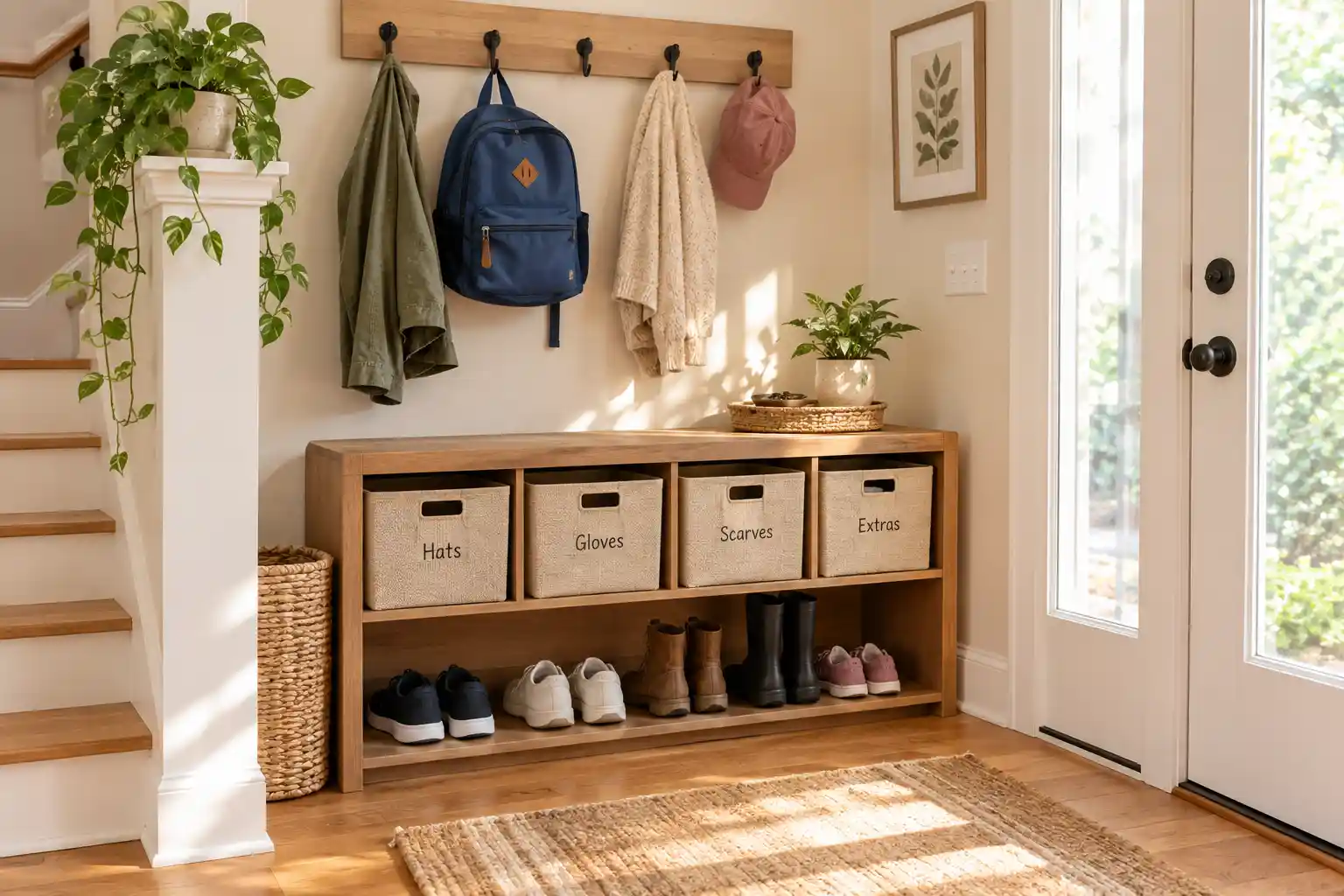
Every family needs one spot near the entry door where backpacks, shoes, and coats land. And the projects that work share one trait. They’re positioned exactly where people naturally drop things, not where organization theory says they should go. Watch where backpacks actually end up for a week before building anything usually it’s a specific spot near the door, not wherever you’d prefer.
Build hooks at a height kids can actually reach without help. Mounted low enough for a six-year-old and adjustable or duplicated at a higher level for teenagers and adults. A bench with cubbies underneath solves shoe storage without requiring anyone to bend down and align shoes neatly. Which is a step most kids simply won’t do consistently regardless of how many times you ask.
Where Should a Family Landing Zone Actually Go?
Wherever backpacks and shoes currently land naturally. Even if that’s not the location you’d ideally choose working with existing behavior patterns consistently outperforms trying to redirect a whole family’s habits toward a more “correct” spot near a different door.
Project 2: Under-Bed Storage for Out-of-Season Everything
Rolling storage bins built for under-bed clearance solve a genuine space problem in kids’ rooms without requiring any new furniture or floor space. Measure your specific bed’s clearance first this varies more than people expect between bed frames before buying or building bins. Since a bin that’s an inch too tall simply won’t work regardless of how well-organized its contents are.
Label bins by season or by size (next size up in clothing, current out-of-season items) rather than by specific category. Since broad labeling survives inconsistent use better than an elaborate system nobody maintains precisely.
Project 3: A Command Center That Isn’t Just for Parents
A wall-mounted family command center works when it includes something for each kid to check themselves a visual chore chart. A simple calendar with color-coded activities per family member rather than existing purely as a parent’s planning tool that kids never actually reference. Involving kids in checking their own information, even simple picture-based icons for younger children. Builds independence rather than creating one more thing a parent has to manage and communicate verbally every morning.
What Should Actually Go on a Family Command Center?
At minimum, a shared calendar visible to the whole family, a simple chore or responsibility chart kids can check themselves. And a designated spot for permission slips or paperwork that needs a parent’s signature, positioned at a height kids can actually reach and use independently.
Project 4: Toy Rotation Storage That Reduces Daily Clutter
Rather than keeping every toy accessible at all times. A rotation system using labeled bins in a closet or garage with only a portion of toys out at any given time genuinely reduces daily clutter while making rotated-in toys feel newly interesting again when they reappear. This isn’t about owning fewer toys; it’s about not having every single one competing for floor space simultaneously.
Swap bins every few weeks on a loose schedule rather than a rigid one. And let kids help choose what comes out during the swap. Which builds buy-in for the system rather than making rotation feel like something being done to them without input.
Project 5: A Homework Station Stocked Before It’s Needed
A dedicated homework spot even a small corner rather than a full desk works best when basic supplies (pencils, paper, a calculator, tape) live there permanently rather than requiring a hunt through the house every time homework starts. The friction of gathering supplies is often the actual reason homework time devolves into stalling and complaints, more than the homework itself.
Does a Homework Station Need to Be a Full Desk Setup?
No a small caddy or organized drawer with basic supplies. Positioned anywhere quiet enough for focus, accomplishes the same goal as an elaborate desk setup. Since consistent supply access matters more than the specific furniture involved.
Project 6: Labeled Bins for Shared Bathroom Chaos
A shared kids’ bathroom accumulates chaos fast without some system for separating each child’s specific items. Simple labeled bins or baskets, one per child, kept on open shelving rather than inside a cabinet. Reduces the daily “whose toothbrush is this” friction and makes it obvious at a glance whose items need restocking.
Project 7: A Rotating Memory Box for Kids’ Artwork
Every family accumulates more kids’ artwork than any reasonable amount of wall or storage space can hold. And the projects that work involve a genuine editing step, not just endless accumulation. A single labeled box per child. With a simple rule new art in means an older piece gets photographed and then recycled keeps the collection manageable without losing the sentimental value entirely.
Conclusion
DIY organization projects for families succeed when they’re built around how people actually behave under real daily pressure, not around an idealized version of a tidy household. A landing zone positioned where backpacks genuinely land, a toy rotation system kids help manage, and a homework station stocked before it’s needed all share the same underlying principle: reduce the effort required to maintain the system, and it survives; demand precision, and it collapses within weeks. Start with whichever project addresses your household’s most frequent daily friction point, and build from there.
FAQs
What’s the most important factor in whether a family organization system actually lasts?
How much effort the “putting away” step requires systems that demand quick, low-precision actions survive daily use far better than elaborately sorted systems that require more time and attention than a busy family will consistently give them.
Should kids be involved in setting up organization projects, or is it better for parents to design them?
Involving kids, even young ones, in decisions like toy rotation or chore chart design genuinely improves buy-in and consistent use compared to systems imposed entirely by a parent without input.
How often should a toy rotation system be swapped?
Every few weeks on a loose, flexible schedule works better than a rigid calendar, since forcing an exact schedule adds unnecessary pressure to a system meant to reduce household stress, not add to it.
What’s a low-effort way to manage the overwhelming amount of kids’ artwork?
Use one labeled box per child with a simple rule that new art coming in means an older piece gets photographed and recycled, which keeps the collection sentimental and manageable rather than endlessly growing.
5 thoughts on “DIY Organization Projects for Families: 7 That Actually Survive Kids”